Why is Diocletian’s Palace a must-visit attraction?

Inside Diocletian’s Palace, daily life unfolds within ancient walls, with cafés set up in old courtyards and homes tucked into what were once imperial quarters. Built for Diocletian in the 4th century, the palace isn’t separated from the city—it is the city.

Layers of history show up everywhere. Roman foundations sit beside medieval buildings and later additions, all blending without feeling staged. You’ll drift between open spaces like the Peristyle and tighter lanes filled with local spots and quieter corners.

There’s no fixed route here, which makes exploring it feel easy and unforced—more like wandering through a neighborhood than ticking off a landmark.

What to see at Diocletian's Palace

Peristyle (Central Square)
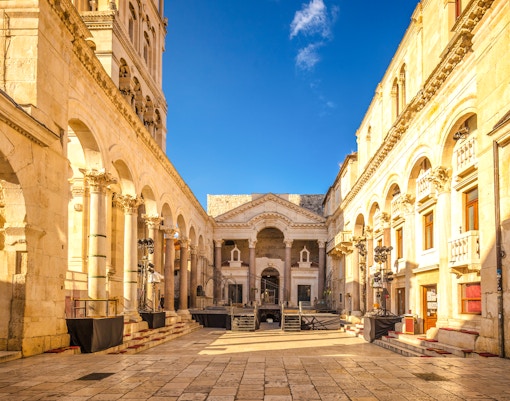
The grand open courtyard where columns frame the sky and history unfolds around you. This was the ceremonial heart of the palace, and today it’s often filled with live performances and gatherings.

Cathedral of Saint Domnius

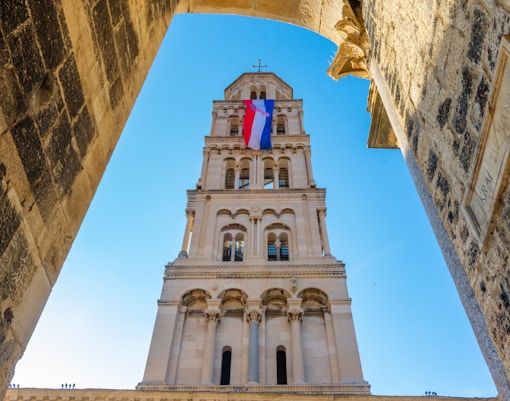
Originally built as Diocletian’s mausoleum, this structure is now one of the oldest cathedrals in the world. Inside, you’ll find intricate carvings, religious art, and a chance to climb the bell tower for city views.

Temple of Jupiter

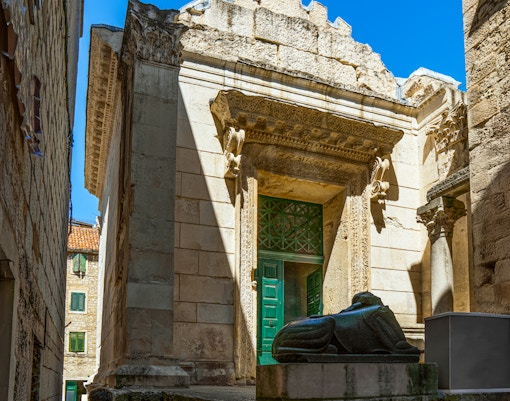
A compact yet striking Roman temple dedicated to Jupiter, later converted into a baptistery. Look out for the detailed ceiling and the imposing sphinx guarding the entrance.

Underground Cellars

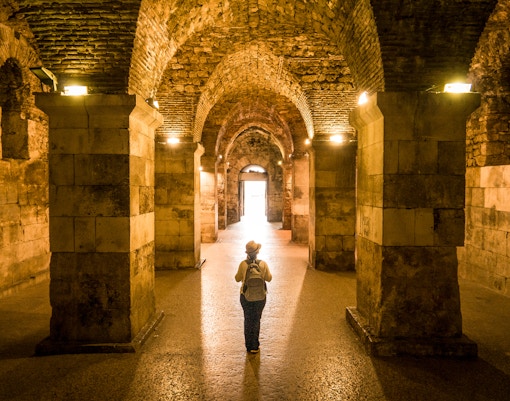
These well-preserved substructures mirror the palace above and offer a glimpse into its original layout. Walking through these stone halls feels atmospheric and slightly surreal.

Highlights of Diocletian’s Palace in Split

Placeholder Image Headout Blimp

Golden Gate

The grand northern entrance once used by the emperor, now a key access point into the maze-like streets of the palace.

Placeholder Image Headout Blimp

Brief history of Diocletian’s Palace

Built at the turn of the 4th century AD, Diocletian’s Palace was commissioned by the Roman emperor Diocletian as his retirement residence. Constructed between 295 and 305 AD, it combined the layout of a military fortress with the comforts of an imperial villa.

After Diocletian’s death, the palace continued to function as an administrative and residential complex. In the 7th century, when nearby Salona was abandoned following invasions, refugees settled within the palace walls, transforming it into a living city. Over time, medieval houses, churches, and later architectural styles were built into the original Roman structure.

Through centuries of change under Byzantine, Venetian, and Austrian rule, the palace remained continuously inhabited. Today, it stands as one of the best-preserved Roman complexes in the world and forms the historic core of Split.

Architecture of Diocletian's Palace

Who built Diocletian’s Palace?

Diocletian commissioned the palace as his retirement residence in the late 3rd century AD. While the exact architects remain unknown, it was built by skilled Roman engineers and craftsmen using materials sourced from across the empire, reflecting imperial power and practical design.

Architecture of Diocletian’s Palace

Constructed between 295 and 305 AD, the palace blends Roman military and residential architecture. Its rectangular layout follows a fortified camp (castrum) design, with high defensive walls, watchtowers, and four main gates. Inside, the southern half facing the sea was designed for the emperor’s private quarters, while the northern section housed soldiers and servants.

Built using limestone from nearby quarries, along with marble and decorative elements imported from Egypt and Greece, the structure reflects both durability and grandeur. Key architectural features include the Peristyle courtyard with its colonnaded façade, the octagonal mausoleum (now the Cathedral), and the Temple of Jupiter.

Over centuries, medieval and later additions were integrated into the original Roman framework, creating a layered architectural style that remains visible today.

Frequently asked questions about Diocletian’s Palace

No, entry to the palace itself is free since it functions as part of Split’s old town. However, specific sites like the Cathedral, bell tower, and cellars require separate tickets.